
July 10, 2026
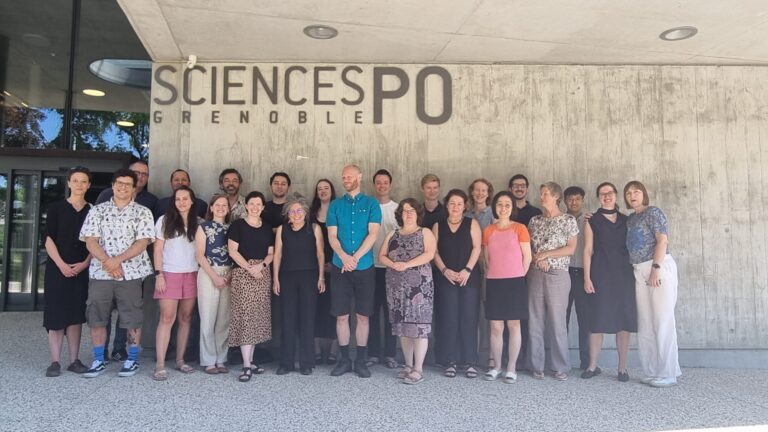
Group picture of workshop participants, from left to right: Simone Schneider, George N. Georgarakis, Annalena Oppel, Amber Wichowsky, Meghan Condon, Leslie McCall, Aaron Reeves, Nadja Wehl, Jolanda Jetten, Xian Huang, Andrea Grisold, Silke Goubin, Sonja Zmerli (first row); Matthew Loveless, Juan Diego García-Castro, Juan Carlos Castillo, Cristóbal Moya, Hannah Waldfogel, Christian T. Elbæk, Tijs Laenen, Elizabeth Suhay, Franco Bastias, Hongfei Du (second row)
Private Picture | Sciences Po Grenoble
An international and interdisciplinary dialog on Representations of Economic Inequality and Their Consequences was held at Sciences Po Grenoble – Université Grenoble Alpes from July 8–10, 2026. The three-day meeting brought together around 30 researchers from across the globe. Participants addressed a broad range of questions concerning inequality perceptions, social justice and redistribution, political responses to inequality, and the role of media and political communication. The interdisciplinary format made it possible to connect different theoretical traditions and methodological approaches and to consider how insights from psychology, sociology, political science, economics, and communication can complement one another in understanding inequality perceptions.
The workshop was organised by Sonja Zmerli, in collaboration with Silke Goubin, as part of the ERC-funded project POLINEQUAL – The Politicisation of Economic Inequality. POLINEQUAL investigates the causes and political consequences of citizens’ perceptions of economic inequality, focusing in particular on the role of welfare regimes, ideological cues, media representations, and individual experiences in shaping perceptions and justice evaluations.
The meeting also strengthened the connection between PERGAP and POLINEQUAL, two ERC-funded projects that approach the study of inequality perceptions from complementary angles. POLINEQUAL focuses on the politicisation of economic inequality in three countries, representing different kinds of welfare regimes: Great Britain, Sweden, and France. PERGAP places greater emphasis on the role of institutional contexts and on how institutional arrangements across 50 countries can be compared and empirically assessed, to then study their potential influence on perceptions, evaluations, and preferences concerning inequality in a large-N framework. Bringing these perspectives together creates promising opportunities for future comparative research and interdisciplinary collaboration.
Special thanks go to Sonja Zmerli for the invitation and for hosting the workshop.
Learn more about the ERC-funded POLINEQUAL project here: