
Feb 19, 2026
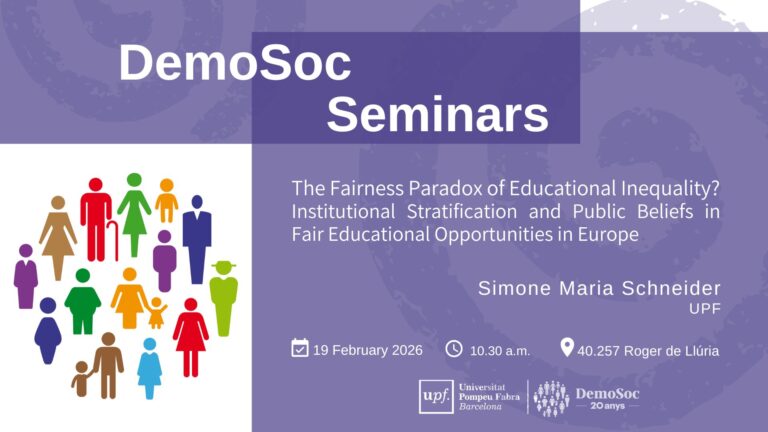
Header of the Advertisement of the Demosoc Seminar Series at Universitat Pompeu Fabra
Sociodemography Research Group (DemoSoc)
Dr. Simone Schneider presented ongoing research from the PERGAP project at the DemoSoc Seminar at Universitat Pompeu Fabra (UPF) in Barcelona. Her talk, The Fairness Paradox of Educational Inequality? Institutional Stratification and Public Beliefs in Fair Educational Opportunities in Europe, focused on the relationship between educational tracking and public understandings of fairness and equal opportunity.
Educational tracking – the practice of allocating students to different educational pathways according to academic performance or perceived ability – is one of the most consequential institutional features of education systems. European countries differ substantially in when and how strongly students are separated into different tracks, with important consequences for educational careers and the reproduction of social inequalities. Yet the institutional organisation of education may matter not only because it structures opportunities directly. It may also shape how people understand and evaluate those opportunities.
The presentation explored this latter dimension, asking how institutional arrangements become connected to public beliefs about the fairness of educational opportunities. Rather than treating educational tracking solely as a mechanism that distributes educational chances, the study considers it as an institution that can also influence the ideas, expectations, and standards through which educational inequality is interpreted.
This perspective connects closely to PERGAP’s broader research agenda. The project investigates how institutions shape perceptions, evaluations, and preferences concerning social inequality. Educational opportunities provide an important case for this research because beliefs about equal opportunity are closely intertwined with meritocracy and with the question of whether unequal outcomes are considered legitimate. Examining educational tracking therefore makes it possible to study how institutional arrangements and public understandings of inequality interact.
The seminar provided an opportunity to discuss the theoretical and comparative challenges involved in studying educational tracking and its relationship to public opinion. In particular, the discussion addressed how differences between education systems can be conceptualised and compared, and how institutional arrangements may become reflected in the ways people understand fairness and opportunity.
The presentation took place within DemoSoc, the Sociodemographic Research Group of the Department of Political and Social Sciences at Universitat Pompeu Fabra. DemoSoc brings together researchers working across demography and sociology, with a strong emphasis on quantitative, comparative, and interdisciplinary approaches to population processes and social stratification. Its research covers areas including education, social inequality and stratification, family and fertility, migration, labour markets, health, and population change. The DemoSoc Seminar Series provides a forum for members and invited researchers to present and discuss ongoing research.
For PERGAP, DemoSoc provides an important intellectual environment at UPF, connecting the project’s research on institutions and inequality perceptions with broader work on social stratification, education, and demographic and sociological change. The seminar was an opportunity to share ongoing PERGAP research with colleagues and students, and to further develop the dialogue between institutional and stratification research.
Learn more about the DemoSoc Research Group here: