
July 12, 2025

Banner for 5th ISA Forum of Sociology 2025.
International Sociological Association (ISA)
Dr. Simone Schneider presented research from the PERGAP project at the 5th ISA Forum of Sociology, held in Rabat, Morocco, from July 6–11, 2025. Organised around the theme “Knowing Justice in the Anthropocene” the forum brought together sociologists from around the world to discuss contemporary questions of inequality, justice, social change, and the role of institutions.
Simone contributed two presentations that addressed complementary dimensions of the PERGAP research agenda: the institutional foundations of social disparities enshrined in social security systems and the ways in which institutional contexts shape public perceptions of fairness and inequality.
In the session “Social Indicators for the Study of Public Policies on Socioeconomic Inequalities” (RC55 Social Indicators), Simone presented Institutional Imprints of Social Disparity: Introducing a Novel Conceptual Framework for the Development of New Institutional Indicators on Social Inequality. The presentation introduced a new conceptual framework for identifying and measuring the ways in which social disparities are embedded in institutional arrangements. Rather than focusing exclusively on welfare-state spending or social outcomes, the approach considers the institutional rules and structures through which states distribute resources, opportunities, and risks. Developing comparable institutional indicators is a key element of PERGAP’s efforts to understand how institutional contexts contribute to the production and perception of social inequality.
Simone’s second presentation, Beliefs in Equality of Educational Opportunities: A Comparative Study of 20 European Countries, was presented in the session “Comparative Attitudes Toward Social Redistribution, Inequality and Inclusivity” (RC42 Social Psychology) organised by Nate Breznau and Juan Carlos Castillo. The study examined how educational stratification – commonly referred to as tracking or ability grouping – relates to how Europeans assess the fairness of their own and others’ educational opportunities. Drawing on cross-national survey and institutional data covering 29 European countries, the study was guided by neo-institutionalist theory and contrasted three possible functions of tracking: as an institutional barrier, a cognitive constraint, or an ideational source.
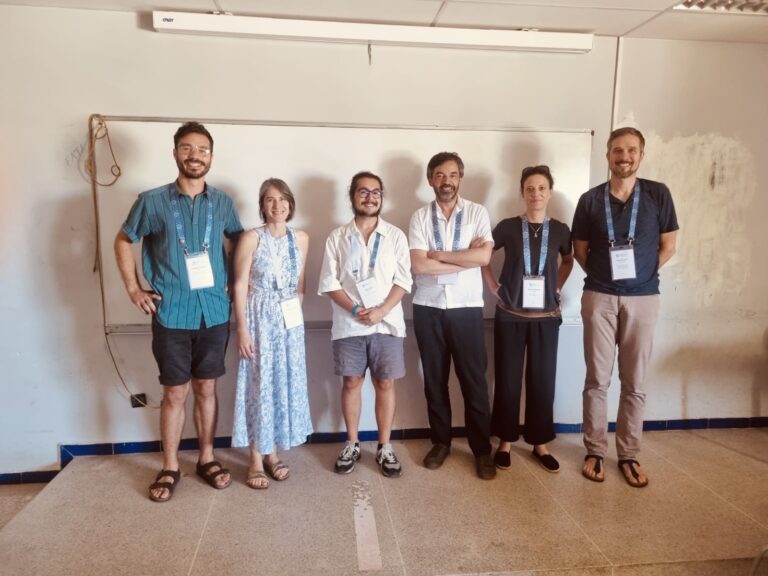
Presenters & organizers of session “Comparative Attitudes Toward Social Redistribution, Inequality and Inclusivity” (RC42 Social Psychology), from left to right: Gonzalo Tranetovic, Mariana Nobile, Julio Iturra, Juan Carlos Castillo, Simone Schneider, Nate Breznau
Together, the two presentations highlight a central concern of PERGAP: understanding the relationship between institutional structures, social inequalities, and public perceptions of fairness and inequality. While the first contribution develops new ways of measuring the institutional conditions in which inequalities are embedded, the second examines how institutional arrangements can shape the ideas and understandings through which people evaluate inequality and fairness. The ISA Forum provided an opportunity to present these ongoing developments of the PERGAP project to an international audience and to engage with researchers working on comparative inequality, social indicators, social psychology, education, meritocracy, and policy feedback.
Learn more about the International Sociological Association (ISA) here: