
June 19, 2026
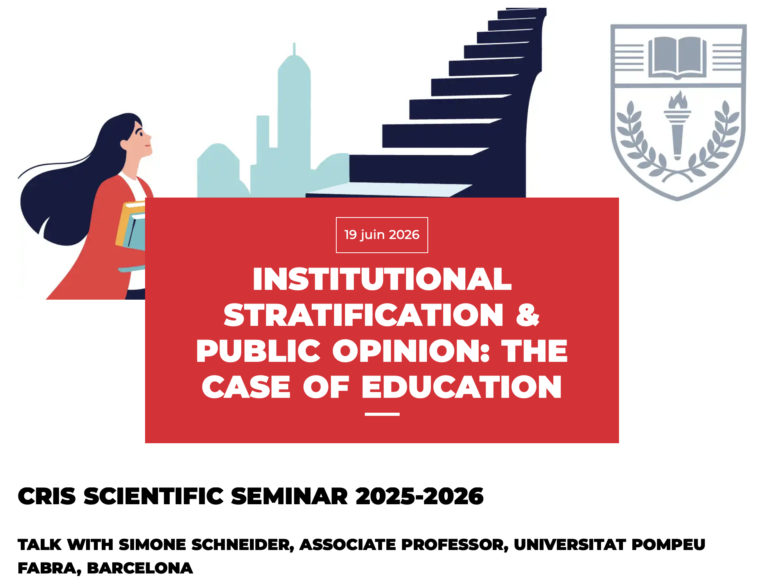
Header to Advertisement of the CRIS Scientific Seminar at Sciences Po | Center for Research on Social Inequalities (CRIS)
Dr. Simone Schneider presented ongoing research from the PERGAP project at the Centre for Research on Social Inequalities (CRIS) at Sciences Po in Paris. The presentation, entitled Institutional Stratification & Public Opinion: The Case of Education, formed part of the CRIS Scientific Seminar series, which brings together researchers to present and discuss ongoing work on social inequalities.
The presentation examined how institutional arrangements in education shape public understandings of educational fairness. Focusing on educational stratification – commonly referred to as tracking or ability grouping – Simone discussed how the organisation of education systems can influence the ways in which individuals assess the fairness of their own educational opportunities and those available to others.
Drawing on comparative survey and institutional data from European countries, the research develops a neo-institutionalist perspective on the relationship between educational institutions and public opinion. It distinguishes between three possible functions of educational tracking: as an institutional barrier, a cognitive constraint, or an ideational source. The findings provide support for the latter perspective, suggesting that institutionalised ideas and practices can shape how people understand and evaluate educational fairness.
A particularly striking finding is a “fairness paradox”: on average, educational opportunities in more strongly stratified systems are perceived as being about as fair as those in more inclusive systems. Rather than simply undermining perceptions of fairness, institutional stratification can therefore become normalised and reflected in public understandings of how educational opportunities ought to be organised. For perceptions of one’s own opportunities, this pattern is also partly related to the strong vocational orientation of more stratified educational systems.
The study highlights the importance of looking beyond the direct distributional consequences of institutions and considering their ideational and interpretive effects. Educational institutions do not only structure people’s opportunities; over time, they can also shape the norms and expectations through which those opportunities are evaluated. In this sense, the research contributes to PERGAP’s broader effort to understand how institutional contexts become connected to the perception, evaluation, and legitimation of social inequality.
The presentation was followed by a lively discussion with researchers at CRIS, providing an opportunity to reflect on the theoretical mechanisms linking institutional structures and public opinion, as well as on the comparative measurement of educational stratification and perceptions of fairness. The exchange offered valuable feedback for the ongoing development of the research and strengthened links between PERGAP and the research community at Sciences Po.
Special thanks go to Bastian Betthäuser for the invitation and for hosting the presentation at CRIS.
Learn more about the Center for Research on Social Inequalities at Sciences Po here: